
20 Nov Identical Imperfections
by Carolina Marchiori
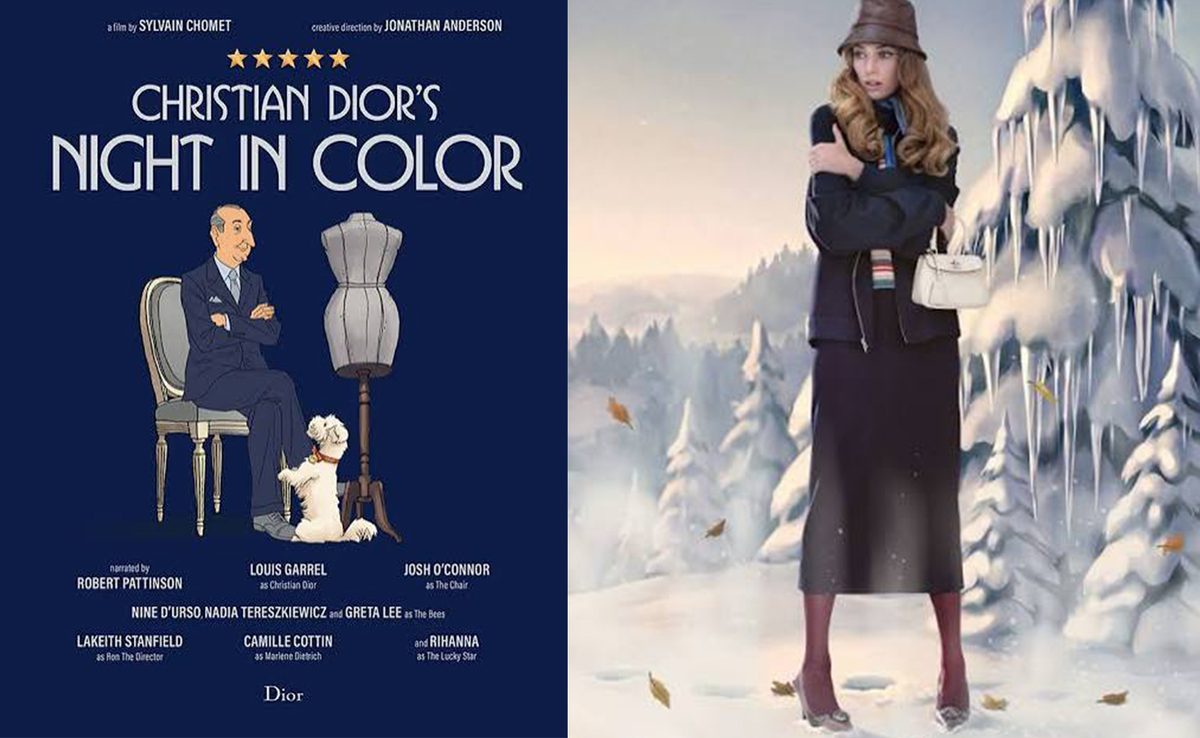
n one frame of Christian Dior’s Night in Color, the house’s Christmas film for 2026, a hand has six fingers. Within a day of the film’s release on 4 November, viewers were pausing it, circling the frame and posting screenshots. Dior had presented the six-minute short, directed by Sylvain Chomet, as a work whose patience matched that of couture, and Jonathan Anderson had said it was drawn entirely by hand, with techniques going back to the 1940s. Shortly after, Cartoon Brew took the word “hand-drawn” out of its headline.
Chomet answered in Variety. In traditional animation, he said, a hand opening like a fan can show six or seven fingers for a few frames, because the drawing records the speed of a gesture. His producer, Aton Soumache, conceded that automated interpolation had filled in some of the in-between frames, a very small part of the process. The drawings themselves were made on graphics tablets. Studios have used software for in-betweens for years, and none of this amounts to a scandal, at least not to me.
I use AI almost every day, and I love what it does for my ideas: it throws things back at me I wouldn’t have thought of, and it lets me try out more versions of a first draft than I ever could on my own. Before I reach for AI, I ask what it is meant to do here, and whose idea it is serving. The work itself hasn’t got that much shorter. A good image or article still takes hours and a lot of care. AI is one more tool on a palette that already holds pencil, paper, Word and Photoshop, and the tablets Chomet’s team drew on.
Before I reach for AI, I ask what it is meant to do here, and whose idea it is serving.
What is new is the scene: a film sold on the promise of the human hand, and an audience going through it frame by frame, the way a jeweller goes over a stone with a loupe. Many of them had another film fresh in mind.
A week earlier Prada had released Drawing Prada, winter landscapes animated frame by frame by a team under the former Disney animator John Pomeroy and photographed by Glen Luchford, in which mice make off with Sadie Sink’s shoes.
Since then the season has filled up with the same idea in different materials. On 12 November Loewe launched a collection built on Tim Burton’s The Nightmare Before Christmas, framed as an encounter between stop-motion puppetry and the house’s leatherwork, with Burton in the teaser saying how beautiful it is to see things made by hand. Barbour has given its Christmas to Aardman for the fourth year running, and this time Wallace ends up in a snowdrift, thrown from an armchair rolling on Barbour wellingtons. Bottega Veneta brought in the Moomins, Lemaire printed Roland Topor. Diptyque set its gifts in a woodland of turned wood and blown glass made by Jean-Simon Roch. Rimowa has built miniature worlds of clay, paper, felt and wood inside its aluminium suitcases and animated them in stop-motion. Porsche asked the animator Em Cooper to paint, frame by frame and in oil, the story of a couple who spent two years restoring a 1966 Porsche 912, drove it up the Pacific Coast Highway and brought it to their wedding.
Below luxury, the same film keeps being made. Levi’s built a clay yeti with the studio Blinkink, at four hours of shooting for every second on screen. The beauty brand e.l.f. made its first Christmas film in stop-motion and sculpted the puppets’ eyelids from wax and clay so that the animators’ fingerprints would stay visible.
Campaign had already asked in January whether 2026 would be the year of “imperfect” creativity, a retreat from AI-polished perfection. It would be easy to call this a war between hand and machine, but the year doesn’t bear that out. In February, before Demna’s first show for Gucci, the house teased the collection with AI images, among them a Milanese grandmother in vintage Gucci who had never existed. People wondered why a house that sells craft couldn’t find a real grandmother to photograph, and Valentino’s AI adverts met the same response from its own followers. Yet when Guerlain marked the 170th birthday of its Bee Bottle in 2023 with more than eighteen hundred images generated from its own archive, the film was praised and went on to win awards.
The difference lies in the brief. Guerlain’s agency began by asking what could be said about Guerlain “and only Guerlain” through AI, and gave the machine an archive no other house owns. The grandmother could have belonged to any house. By Christmas Gucci had swapped her for Mariah Carey, who is very real and could just as easily be checking into a hotel for Versace. The problem was never that the grandmother wasn’t real, and to me it was never that Dior let software help with the in-betweens.
6
Fingers on a single hand in one frame of Dior’s Night in Color.
1,800
Bee Bottles generated by an AI model Guerlain trained on its own archive.
4
Hours of shooting for every second of Levi’s stop-motion holiday film.
None of this makes the films any less good. In Dior’s, a chair answers the phone in Josh O’Connor’s voice and the seamstresses buzz through the atelier as bees. In Prada’s, three mice drag a spotted loafer across the floorboards with Sadie Sink crawling after them. In twenty years of commissioning images for magazines and brands, I have rarely seen a technique settle anything, my own briefs included. What counts is what it lets slip about the brand.
Euronews called Prada’s film effort signalling. Fair enough. But effort is hard to signal when the house next door is doing the same thing that week, and the week after. Within a fortnight people were watching these films for the seams rather than the story. Barbour seems untouched by it. Wallace has turned up in its Christmas for four years now, long enough for the habit to belong to the brand, the way drawing belongs to Hermès.
While one half of the industry went back to the drawing board, the other half threw a party. Gucci checks Mariah Carey into a hotel, Burberry fills Longleat House with friends from film, fashion and sport, and by the end of the night Pierce Brosnan is dancing under a disco ball. Louis Vuitton films its party like a vlog in a city apartment, and Tory Burch takes a group of friends to a sunlit country estate, where Christmas comes with lawns instead of snow. The quieter houses keep it in the family: Miu Miu sets a townhouse Christmas in front of Tina Barney’s camera, and Ralph Lauren goes back to the lake house, as it does every year. It’s the opposite of the pencil, yet also these films, for all their charm, begin to resemble one another. But a room full of faces everyone recognises doesn’t need to prove AI was not involved – at least not yet.
Seen together, the season shows that saying no to AI has become a trend of its own, and it runs strongest in the houses whose whole story is savoir-faire. It is the obvious move. A house that knows what it stands for can afford to ignore the trend in either direction.
I’ll admit it: by mid-November I’d had my fill of felt and clay and happy disco balls. I’m glad human creativity is back on screen, I really am, but somewhere between the Moomins and the yeti I found myself wanting a Christmas that walks in late, in black silk and champagne. Grown-up, elegant and without apologies.
For those of us who outgrew the cartoons a while ago, Chanel had already shown something braver. Last December it asked Michel Gondry to make a short film for Matthieu Blazy’s first Métiers d’art collection, with Margaret Qualley and A$AP Rocky and original music by Le Motel. Rocky sprints across New York in red silk pyjamas to propose to her outside a subway entrance, and Gondry plays with the city the way only he can: avant-garde camerawork, the speed jumping up and down, and still impossibly chic. It wasn’t a Christmas film, but it could easily have been one, for everyone who falls outside the picture-perfect family Christmas and has something of their own to bring. It fits Chanel like a glove.
Cartier shows the same freedom online. Into the Wild, its world built around the panther, is digital at its best: a place you move through rather than a film you watch, and every corner of it belongs to the animal Jeanne Toussaint made the house’s emblem.
And then there is Ferragamo. The Joy of Loving puts real people in front of the camera. Kris Jenner plays a director holding screen tests, and in come lovers, mothers, sisters and brothers, bandmates and best friends: Paloma Elsesser and her brother Sage, the band Bar Italia, Joan Chen and her daughter, Sofia Testino with her dog. Whatever one thinks of Kris Jenner, it’s an elegant move in a season full of tinsel: no hand-drawn proof, no party, just what people are capable of when they love what they do and the people they do it with. The acting coach Nancy Banks, who appears with her son, says it better than any brief could:
“The joy comes from owning what you can do and knowing that this instrument of you that went through the good, the bad, the ugly in life has figured out how to create something of yourself, from yourself, for others. And it is a beautiful existence.”
Cheers to that, and merry merry.
REFERENCES AND SOURCES
- Campaign. (2026). Will 2026 be the year of ‘imperfect’ creativity?
https://beta.campaignlive.co.uk/article/will-2026-be-the-year-of-imperfect-creativity/4571xvkqzpkpv735qbfvmfykmb - Chayka, K. (2016, August 3). Welcome to AirSpace. The Verge.
https://www.theverge.com/2016/8/3/12325104/airbnb-aesthetic-global-minimalism-startup-gentrification - WWD. (2026, November 3). Dior taps animation director Sylvain Chomet for 2026 holiday campaign. https://wwd.com/fashion-news/designer-luxury/dior-holiday-campaign-animated-short-film-sylvain-chomet-1239398306/
- AV Club. (2026, November 7). The Triplets of Belleville director says AI wasn’t used to generate artwork for his Dior short. https://www.avclub.com/christian-diors-night-in-color-animated-short-alleged-ai-use
- Prada. (2026). Prada Holiday 2026 campaign. https://www.prada.com/at/en/pradasphere/campaigns/2026/holiday.html
- Euronews. (2026, November 2). Prada champions the human touch and not AI slop for their new Christmas campaign. https://www.euronews.com/2026/11/02/prada-champions-the-human-touch-and-not-ai-slop-for-their-new-christmas-campaign
- Jing Daily. (2026, February 26). Gucci faces ‘AI slop’ criticism before Milan show.
https://jingdaily.com/intels/2026-02/26/gucci-faces-ai-slop-criticism-before-milan-show - Marketing Dive. (2023). Guerlain taps generative AI to celebrate the Bee Bottle’s 170th anniversary. https://www.marketingdive.com/news/guerlain-bee-bottle-generative-ai-art-campaign-trail/688553/
- Luma AI. (2026, October 6). 3D and claymation AI prompts 2026.
https://lumalabs.ai/news/3d-claymation-ai-prompts - The Drum. (2026, November 5). Why Barbour keeps coming back to Aardman for Christmas. https://www.thedrum.com/news/why-barbour-keeps-handing-christmas-to-wallace-gromit