
21 Jul Sole. Step. Change.
by Carolina Marchiori
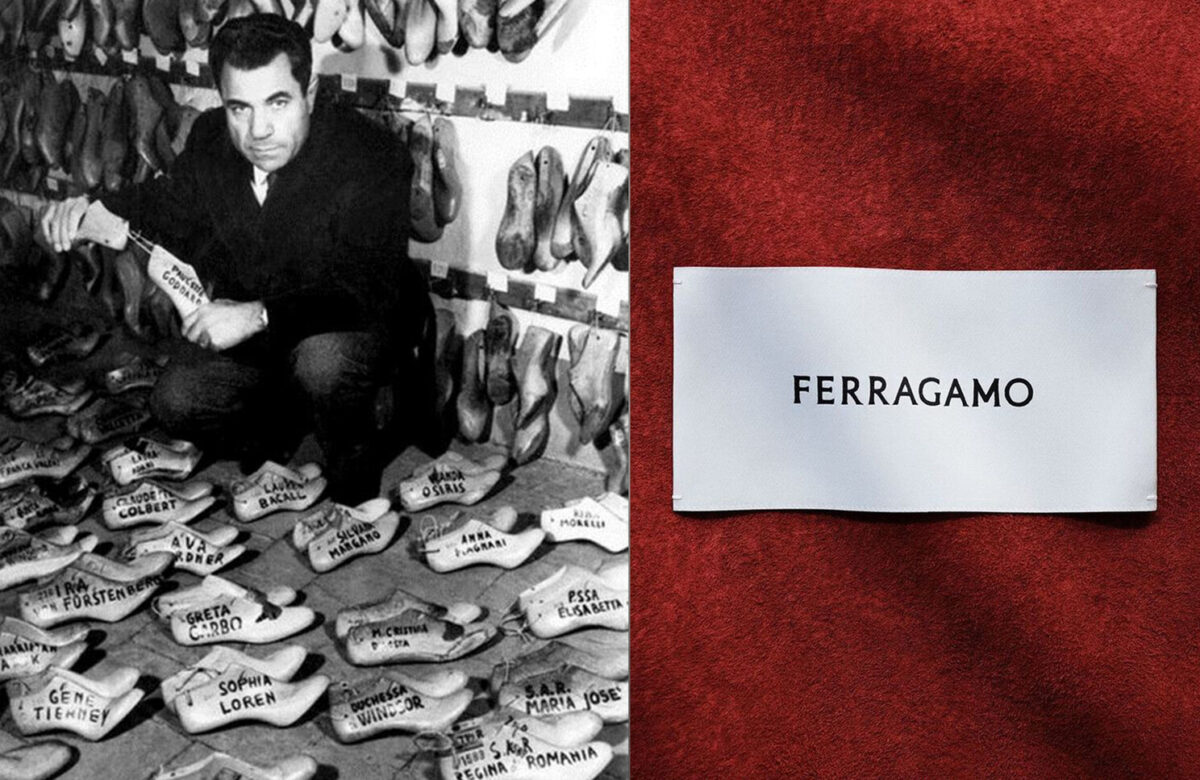
In Florence, on Via Tornabuoni, there is a studio that has been making shoes since 1927. Not approximately since 1927 — since that year, in that city, by that family. I have a copy of Salvatore’s autobiography on my shelf — the red-bound volume, given to me on the day of the shoot. I was Art Director of GG Magazine at the time, and that morning Leonardo Ferragamo, son of Salvatore and Chairman of the Ferragamo Group, had climbed with us onto the roof of Palazzo Spini Feroni — the family’s Florentine seat since 1938 — to recreate an archival photograph of Wanda and the children, taken on that same terrace decades before. He agreed without hesitation, and with what looked like genuine delight in the unconventional interruption. It is where this essay begins: the little red book, the rooftop, and the question of what a house carries when everything else changes.
The autobiography documents, without naming them as such, a sequence of structural reinventions: the same founding intelligence converted into value through five entirely different mechanisms, by five entirely different configurations of people, across a century of upheaval. It reads as biography. It is, in structural terms, a manual for something most brands never manage once.
Every major luxury brand eventually encounters the same crisis: the moment when what it has been doing stops converting into value at the rate it once did. The instinct — almost universal — is to assume the product needs updating, the creative direction needs refreshing, the visual identity is overdue for simplification. Reasonable diagnoses of visible symptoms. Wrong about the underlying condition. The diagnosis that matters asks not what the brand has been doing but what it actually is — the asset at its core — and whether the mechanism converting that asset into desire is still functioning, or whether it has exhausted the logic it was built on.
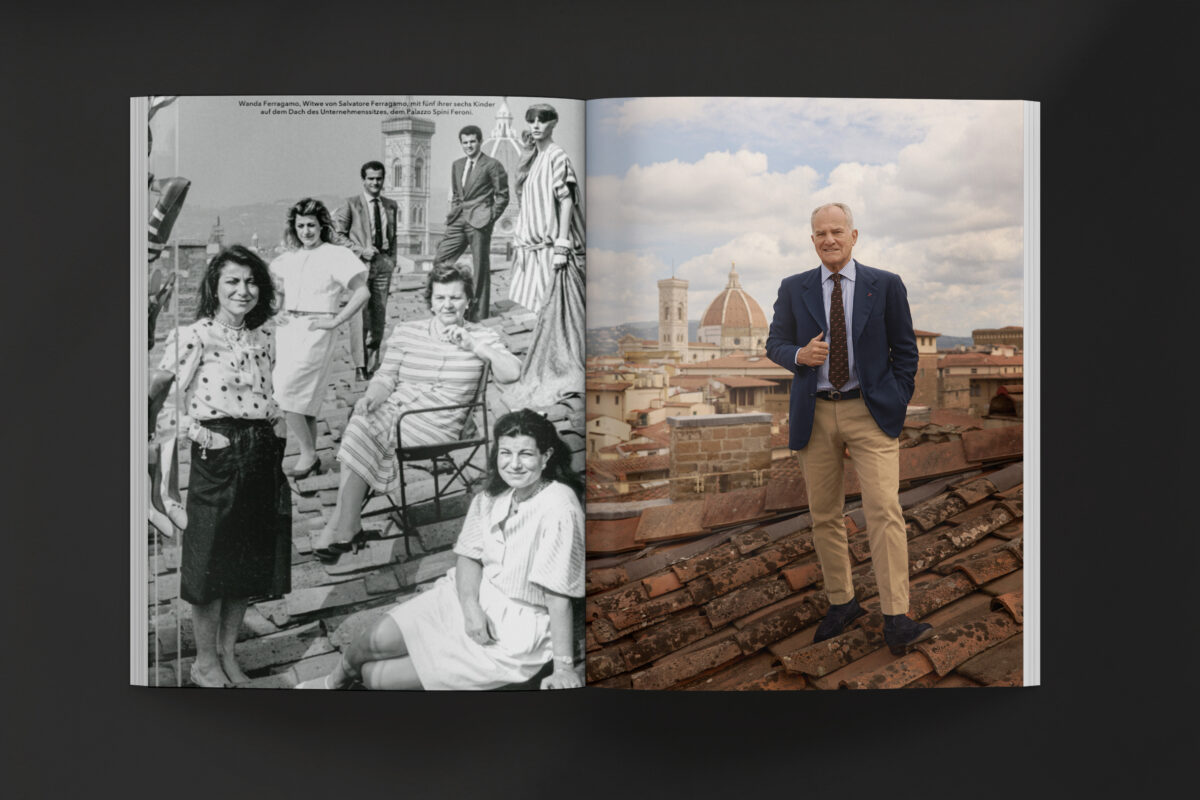
Right: Leonardo Ferragamo on the roof of the Palazzo Spini Feroni © Mark Seelen for GG Magazine
Niklas Luhmann described social systems as operationally closed: self-reproducing structures that translate external pressure into their own existing terms. A brand built exclusively on product logic reads a positioning crisis as a product problem — and responds within that logic, generating product solutions to what is, structurally, a mechanism failure. A house built on founder authority reads institutional transition as a leadership question. This is not failure of intelligence. It is the structural condition of every system: the existing logic is both its competence and its constraint. A step change is not an improvement within that logic. It is the moment when the conversion mechanism is replaced entirely, with the underlying asset held constant.
The distinction between quintessence and mechanism is the most important single insight available to anyone managing a luxury brand through a period of change
Ferragamo has performed this operation five times. Each time, the trigger was not internal — it was the world changing first. In 1927, cinema had invented a new kind of desire: mass-mediated glamour, distributed through stars, consumed by audiences who had never set foot in a couture house. The social rupture was cultural: a new image economy emerged in which stars were the medium and desire was manufactured through projection. Salvatore moved from Hollywood to Florence not as a continuation of his bespoke work for the studios but as a structural replacement of it. The code shifted from craft production for the entertainment industry to a Florentine luxury house serving a global clientele through heritage and cultural authority. A new system was constructed. The old one was not reformed.
In the late 1930s, the social rupture was geopolitical before it was cultural. The League of Nations sanctions on Italy following the invasion of Ethiopia in 1935 cut off access to steel — the material used for internal shoe shanks — and restricted the supply of traditional leathers. A brand trapped inside product logic would have found substitutes within the existing vocabulary and simplified the range. Ferragamo reorganised the production system entirely: cork from Sardinia for wedge soles, raffia, hemp, fish skin, and cellophane in place of conventional materials. The cork wedge was not a product fix. It was the output of a mechanism rebuilt around material scarcity as a creative forcing condition — a redesign of what shoemaking could be, prompted by the removal of what shoemaking had been. The brand emerged from that constraint with a formal and structural vocabulary it could not have developed in conditions of abundance.
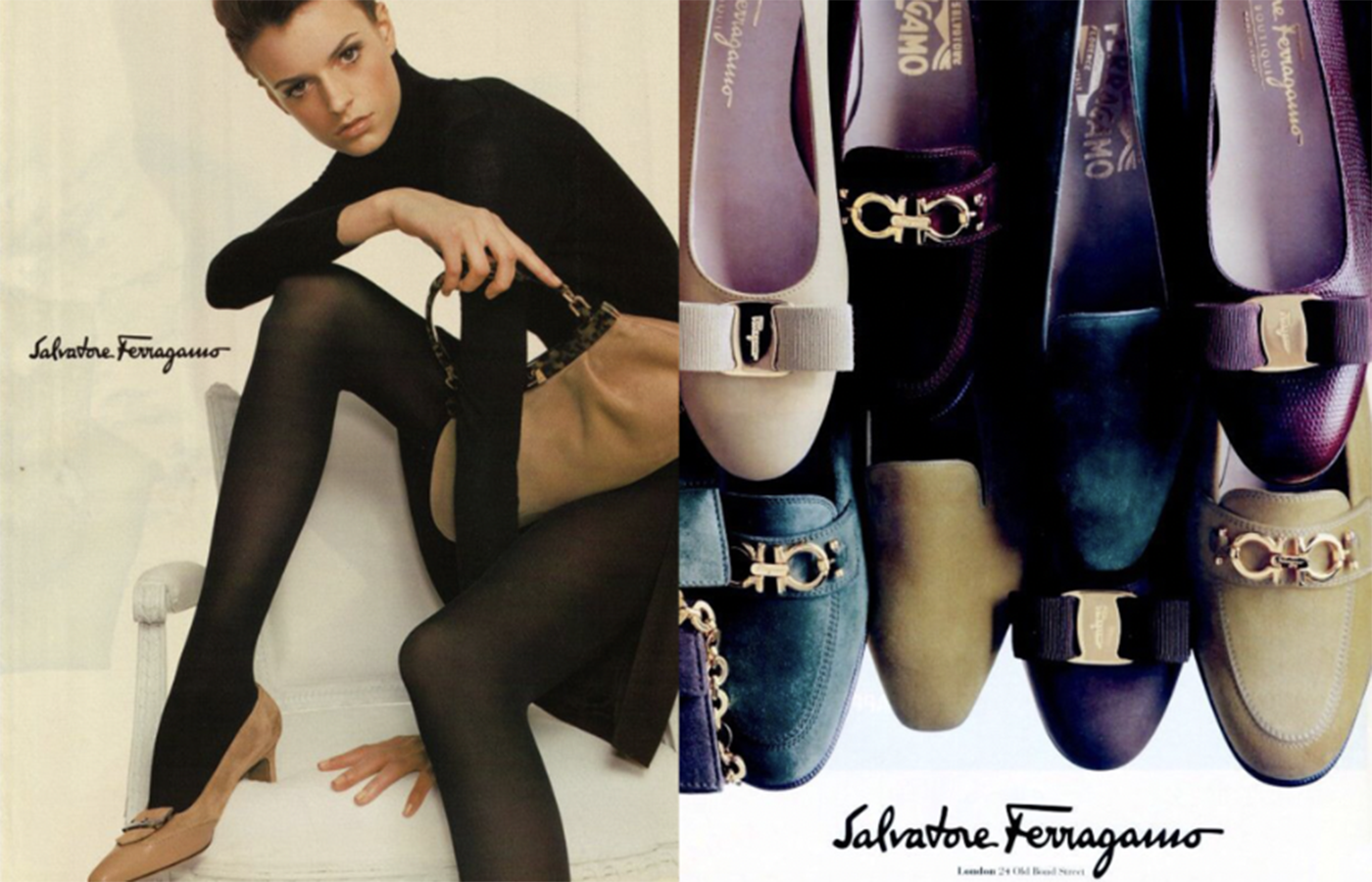
Salvatore’s death in 1960 forced the most demanding transition of all — and it arrived in the middle of a decade that was dismantling the old luxury codes entirely. The counterculture, youth fashion, feminism, the democratisation of style: the world Wanda Ferragamo inherited the house into was not the world her husband had built for. She was thirty-eight years old, with six children between the ages of two and a half and eighteen. What she constructed was not a preservation of his approach but a new self-reproduction mechanism built around the mission of making his extraordinary history a constant presence for those who came after. In Leonardo’s words, spoken to GG Magazine decades later: her life’s work became theirs. Her step. His sole.
“She saw it as her mission to pass on the extraordinary story that had been lived with my father. Through her, his life’s work became a constant presence for us.” – Leonardo Ferragamo
Then the licensing expansion of the 1970s and 80s — itself a response to a social shift: the rise of aspirational consumer culture, a new middle class that wanted a piece of luxury, globalisation opening markets that had never existed before. The brand-as-platform logic was not a mistake of imagination. It was a rational response to a real social change, carried too far.
The most extreme case belongs not to Ferragamo but to Pierre Cardin, who by the mid-1970s had licensed his name to over 900 product lines across 140 countries — frying pans, car interiors, cigarettes. The name remained. The quintessence it had once encoded — Parisian couture, body-conscious tailoring, architectural rigour — ceased to be legible through it. For Ferragamo, the same logic played out at lower temperature: no terminated contract, no public collapse, just a gradual loosening of the quintessence’s signal until the loosening became the condition. The inverse case makes the mechanism failure visible in a single event. Halston, 1983. At his peak: the defining American luxury designer of the 1970s, minimalist sportswear, Studio 54 as the distribution mechanism, Bergdorf Goodman as the retail anchor. The value proposition was exclusivity, which felt like a feature of the product. It was not. Exclusivity was the quintessence — the condition on which every other element depended. When Halston signed the JCPenney deal, Bergdorf Goodman terminated the relationship within days. Not as a negotiating position — as a structural response. Once the quintessence is destroyed along with the mechanism, reconstruction is structurally impossible.
Ferragamo, under Ferruccio’s systematic retraction in the 1990s and 2000s, recognised the drift and reversed it — a step change run backwards, which is structurally identical to running it forwards. The asset was identified. The mechanism was rebuilt around it.
The Moncler case makes the parameters of a successful step change explicit. Remo Ruffini acquired a bankrupt ski brand in 2003. What he acquired was not a business — it was a quintessence: the quilted down jacket as cultural sign encoding technical mastery, alpine origin, and a specific relationship between function and luxury that had no direct competitor anywhere in the market. The old conversion mechanism was functional sportswear through wholesale distribution. Ruffini replaced it entirely, and then replaced the replacement. The first step change (2003–2017) moved the brand into luxury retail, elevated the price point systematically, and built a monobrand store network. Revenue grew from approximately €100 million to over €1 billion. The second step change arrived with the Genius project in 2018: instead of a single creative director interpreting the brand, Moncler became cultural infrastructure hosting simultaneous collaborations — Pierpaolo Piccioli, Hiroshi Fujiwara, Craig Green, among others — each activating the same quintessence through a different cultural lens. The jacket remained constant. The conversion mechanism multiplied. Revenue passed €3 billion by 2024. What Moncler demonstrates is that the quintessence does not limit the mechanism — it enables it.
Notably, Leonardo Ferragamo himself names Moncler alongside Chanel, Cucinelli, and Zegna when describing what independent family ownership makes possible: the freedom to be creative, flexible, and — his word — braver. Pierre Cardin and Halston confused quintessence and mechanism, and destroyed the first by attempting to extend the second. Ruffini kept them structurally distinct, and the distance between them became generative.
The 2022 rebrand under Maximilian Davis is the sixth iteration — and the social pressure driving it is the most complex yet. Digital fragmentation has collapsed the old wholesale logic. Gen Z’s relationship to luxury is built on authenticity and cultural legitimacy rather than aspiration alone. The pandemic accelerated a values shift — toward directness, substance, the rejection of performance. In this context, independence from conglomerate logic is not a liability but a differentiator. Heritage is not nostalgia. It is the most defensible form of authenticity available. The logo shortened by Peter Saville, the surname standing alone, the red returned to Salvatore’s own 1950s shade: each decision reads the social moment and reaches back to the quintessence simultaneously. After nearly a century of shoes — the wedge, the platform, the Vara pump, the cage heel — the defining emblem of the sixth step change is not a shoe. It is a bag.
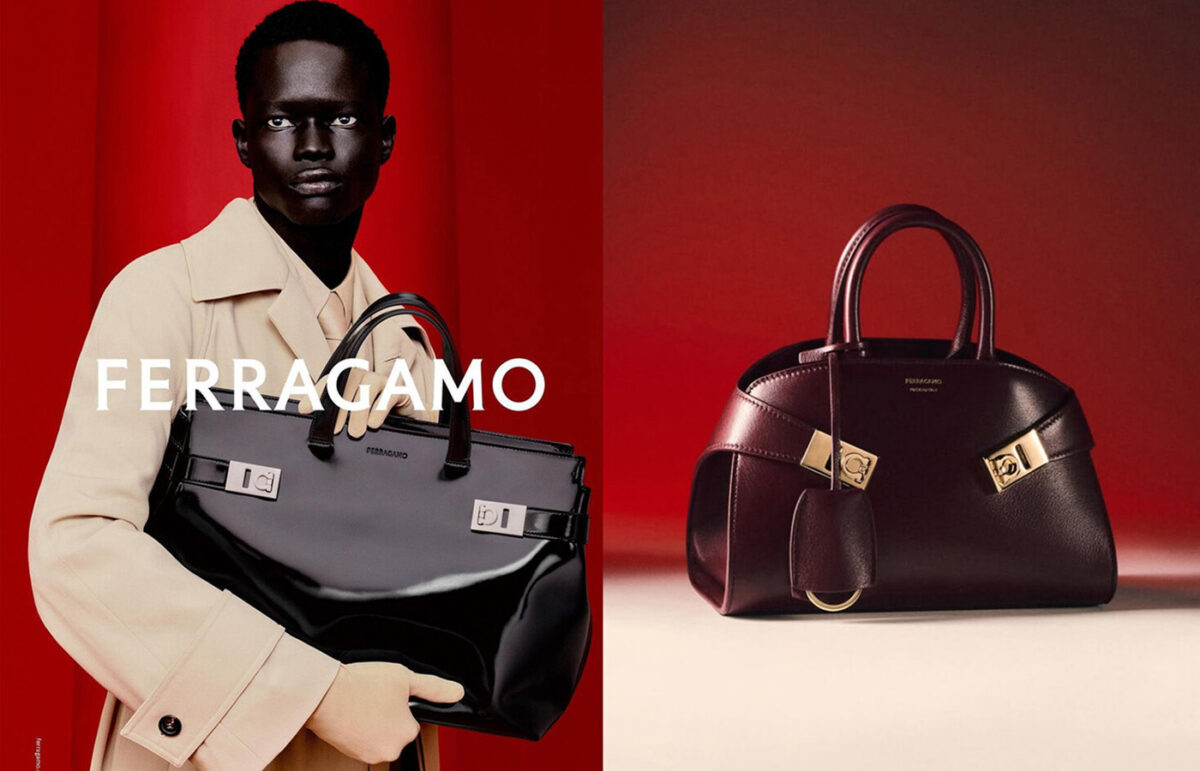
Chol Mabior in the Ferragamo Spring/Summer 2023 campaign by Maximilian Davis © Rafael Pavarotti
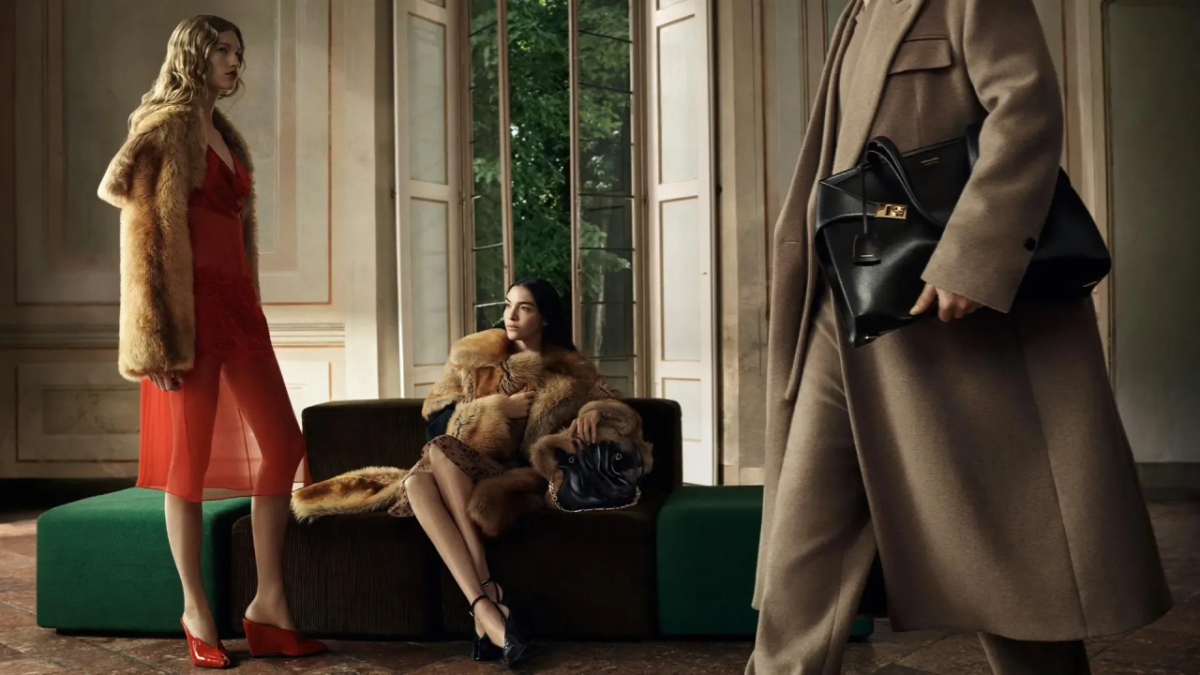
The Hug — Davis’s defining debut piece — is a structured dome shaped leather silhouette. Its hardware is the Gancini clasp — Ferragamo’s signature curved hook closure, introduced in the 1960s during Wanda’s stewardship of the house. The FW 2025 campaign, shot by Craig McDean, makes the cultural reference explicit: Cinecittà, golden-age silhouettes, clothing as narrative and accessories as protagonist. The Vara returns — laminated, elevated, almost sculptural. The archive is not being quoted. It is being renegotiated.
The Hug is gaining ground. Direct-to-consumer outperforms wholesale by nearly twenty points — the same DTC signal that preceded Moncler’s inflection. But a step change requires more than a new framework. It requires enough evidence within that framework to make the previous one feel indefensible — in the store experience, in the cultural presence, in the depth of the product range. The system is in variation. Selection is incomplete. The revenue curve tells the cautionary part of the story: €1.252 billion in 2022, €1.156 billion in 2023, €1.035 billion in 2024, €977 million in 2025. These numbers read as failure only if you mistake them for performance. What they actually show is the instability phase — the window between discarding the old system and the new one reaching conversion velocity. Prigogine called it the condition of structural reorganisation: the moment when the old equilibrium has been broken and the new one has not yet stabilised.
Salvatore wrote about the foot with anatomical precision: its bones, its planes, its weight distribution under motion. He was not describing a shoe. He was describing what the shoe had to do. The asset was never the object. It was the intelligence that could read the body differently — and construct a mechanism to convert that reading into desire. Leonardo Ferragamo, asked what luxury means to him personally, declined to define it by what it is. He preferred to say what it is not: not conspicuous, not extreme, not about being seen. Luxury, he said, is what remains. That sentence contains the entire argument of this essay. The quintessence is what remains when every mechanism has been replaced.
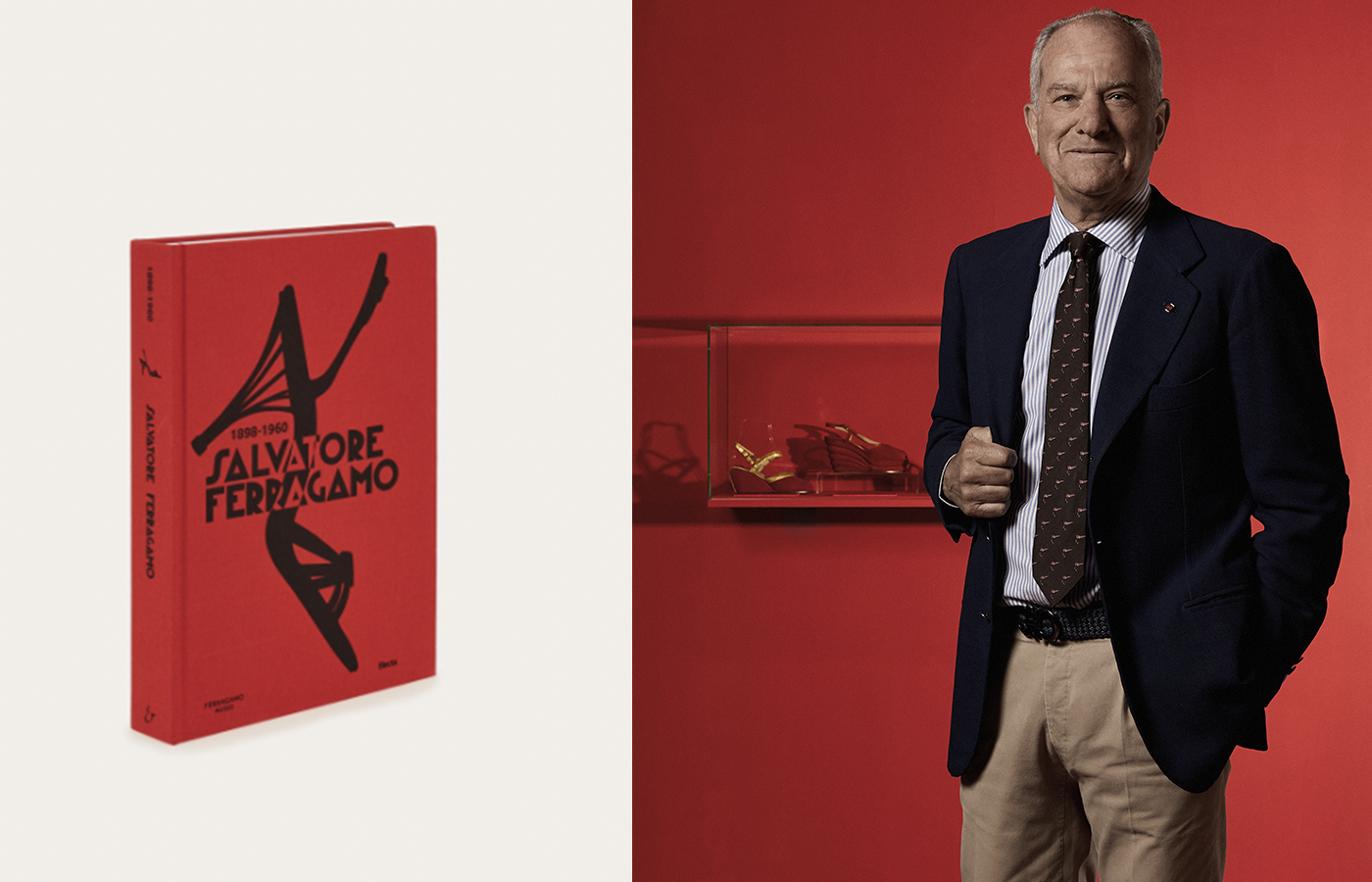
The red book on my shelf is what remains when a life’s work outlives the man who made it. The volume ends at 1957, three years before his death. The house on Via Tornabuoni has been rebuilt around that intelligence five times since. The sixth chapter is still being written — and I am convinced that somewhere in it, once we turn the page, we will see James Ferragamo, son of Ferruccio, former Chief Transformation and now Chief Product Officer, standing on the roof holding a new interpretation of the Ferragamo wedge.
REFERENCES AND SOURCES
- Ferragamo, S. (1957). Shoemaker of Dreams: The autobiography of Salvatore Ferragamo. George G. Harrap & Co. ferragamo.com/museo
- Ferragamo Group. (2022). Annual Report 2022. group.ferragamo.com
- Ferragamo Group. (2025, March 6). FY 2024 full year results. group.ferragamo.com
- Ferragamo Group. (2026). Financial data — investor relations. group.ferragamo.com
- World Footwear. (2026). Ferragamo posts 2025 revenue decline despite fourth-quarter DTC rebound. worldfootwear.com
- Dezeen. (2022, September 29). Peter Saville updates Ferragamo brand identity with custom typeface. dezeen.com
- Ferragamo. (2025). Fall/Winter 2025 campaign. youtube.com
- GG Magazine. (2025). Nicht ohne meine Familie. gg-magazine.com
- The Conversation. (2021). Halston: The glittering rise and spectacular fall of a fashion icon. theconversation.com
- The National. (n.d.). Pierre Cardin: The man with the brand. thenationalnews.com
- Moncler Group. (2017). Annual Report 2017. monclergroup.com
- Dezeen. (2018, February 22). Moncler teams up with eight designers to launch Genius project. dezeen.com
- The Spin-Off. (2025). Moncler Group reaches over €3 billion revenues. the-spin-off.com
- Luhmann, N. (1995). Social systems. Stanford University Press. (Original: Soziale Systeme, 1984)
- Prigogine, I., & Stengers, I. (1984). Order out of chaos: Man’s new dialogue with nature. Bantam Books.