
About this project
Time You Can Feel
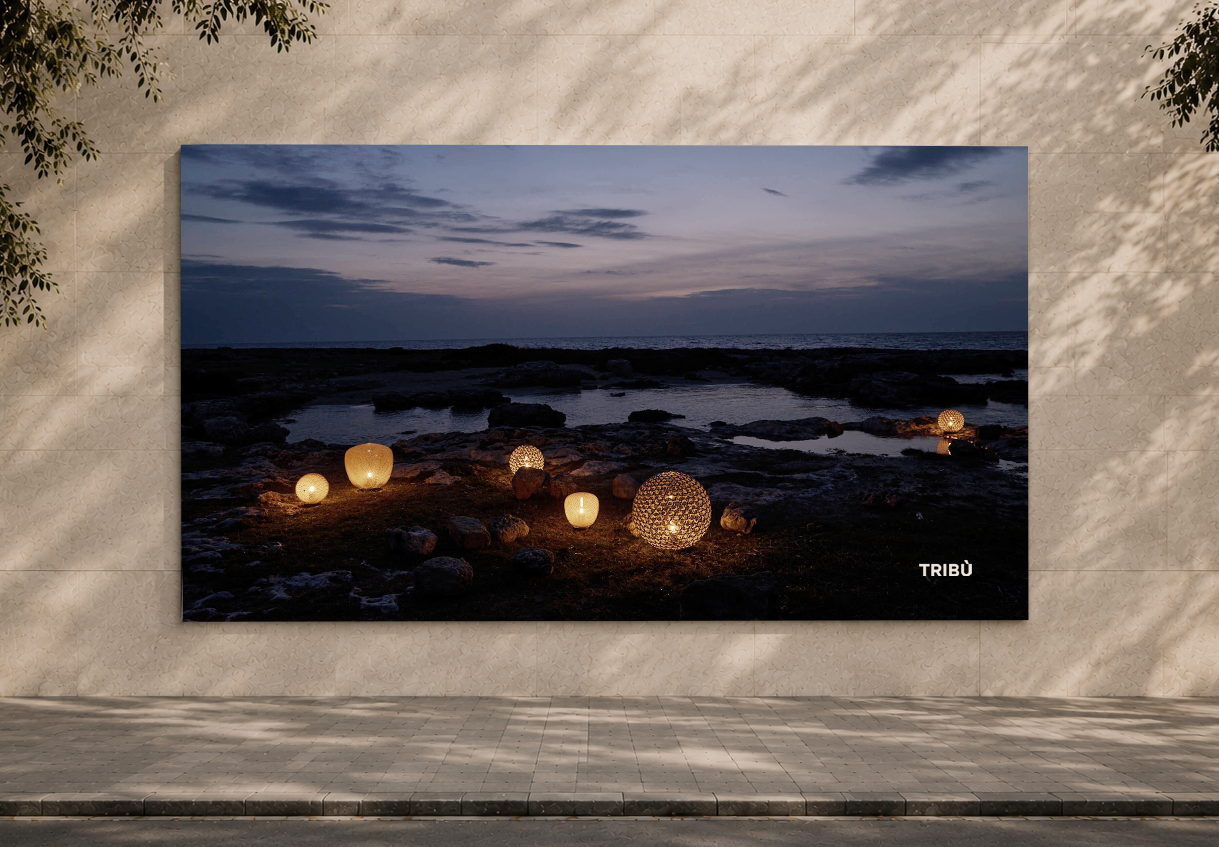
Tribù is a Belgian luxury outdoor furniture brand founded in 1966. Family-owned and engineering-driven, the company builds collections for the long duration — furniture designed to stay in use across decades, shaped by wind, light, and season rather than diminished by them. What began as a location brief for a shoot in Italy became a full brand narrative system: built from what Tribù already understood about time, materiality, and the sensory world of being outdoors — the weight of afternoon light, the sound of wind moving through old trees, the particular stillness of sitting somewhere long enough to feel the air change.
THE SITUATION
At a glance, the premium outdoor furniture market communicates in a single register: product photography at its most precise, light at its most neutral, quality claims that could belong to anyone making a well-built chair for an outdoor terrace. Dedon, Kettal, Gloster — the visual language is largely interchangeable.
The brief arrived as a geography question: which locations in Italy would suit the next campaign shoot? It was the right question, one step too early. Before a landscape can carry meaning, the world the brand inhabits needs to exist with enough clarity that the right setting becomes obvious.
Without a narrative system to make its distinctiveness legible, the distance between the brand and the category was invisible from the outside.
What emerged from the work we did together — going back through sixty years of family ownership, engineering precision, and a genuine culture of outdoor living — was that Tribù had already built that world. The task was not to invent it. It was to make it tangible. To make it something a person could feel, thread by thread.
THE READING
The brand audit began not with references but with a question: what does Tribù actually know that its competitors do not? The answer was not a product advantage. It was a relationship to time.
Tribù furniture is built to last in a literal sense — to resist weather, to age gracefully, to still be the same chair in twenty years that it was on the day it arrived. That engineering fact pointed toward something deeper: a philosophy of outdoor living in which the quality of time spent matters more than the specification of what you sit on. The outdoor furniture category sells objects. Tribù’s real proposition was an experience — slow, sensory, unhurried.
Three latent qualities emerged from the audit: Timeless (heritage since 1966, engineering rigour, longevity as design principle), Modular (collections that combine effortlessly and evolve without obsolescence), Sensuous (materiality that rewards touch, atmosphere that rewards presence). These were not separate brand pillars. They were three dimensions of a single experience — the experience of time that unfolds rather than passes.
The category was communicating objects. Tribù needed to communicate a world.
THE DECISION
The decision was to reframe the entire brief before answering it. Not: where should we shoot? But: what is the sensory world Tribù inhabits, and how do we make that world tangible across every touchpoint?
The campaign anchor that followed was Time You Can Feel — a proposition that operates entirely outside the product register. It does not describe a chair. It describes what happens to a person who sits in one, in the right light, on the right afternoon, in a landscape shaped by the same forces of weather and time that shaped the furniture beside them.
Time You Can Feel unfolds in two chapters. Conversations with Time — developed for the campaign shoot — frames the outdoor experience as a dialogue between person, object, and landscape. Traces of Time, developed for Milano Design Week, moves deeper into the material world: the slow transformation of surfaces, the marks left by weather, light, and years of use.
From this single proposition, everything downstream became legible: the content architecture, the image direction, the social media strategy, and the Traces of Time installation concept for Milano Design Week. A sensory proposition can be demonstrated. It does not need to be explained.
THE WORK
Brand strategy and content architecture built across three dimensions — Timeless, Modular, Sensuous — as the structural logic of Tribù’s visual world. Brand narrative development, visual communication strategy, and a social media content system unifying all three in a single rhythmic logic.
Campaign concept Time You Can Feel. Image direction developed as a coherent visual language: hidden faces, posture and gesture as expression, tactile close-ups, material texture as protagonist. The camera does not document the furniture. It inhabits the world around it.
Scripts for image film and social media content were written in the same register as the visual direction: personal, unhurried, close. Moments rather than messages — a hand on warm stone, light shifting across a terrace, the sound of an afternoon that has stopped asking anything of anyone. The voice, where present, is barely above a whisper. It does not announce. It accompanies.
Traces of Time — the Milano Design Week installation concept — was conceived as a cinematic room: large-format footage from the Salento landscape, two Tribù lounge chairs, a natural sound world of waves, wind, birds, and cicadas. The visitor does not look at the furniture. They sit in it, inside a landscape made of time.
Location research across five Puglia properties, selected for light quality, material coherence, and alignment with the brand’s visual world.
THE SHIFT
A brand that began with a location brief ended with a world. The question of where to shoot resolved itself once the question of what the brand needed to say had been answered — because the world Tribù inhabits has a landscape, and that landscape is recognisable.
Time You Can Feel positions Tribù not as a manufacturer of outdoor furniture but as a brand whose understanding of outdoor living is rooted in something the category cannot easily replicate: a genuine philosophy of time. Not time measured. Time felt.