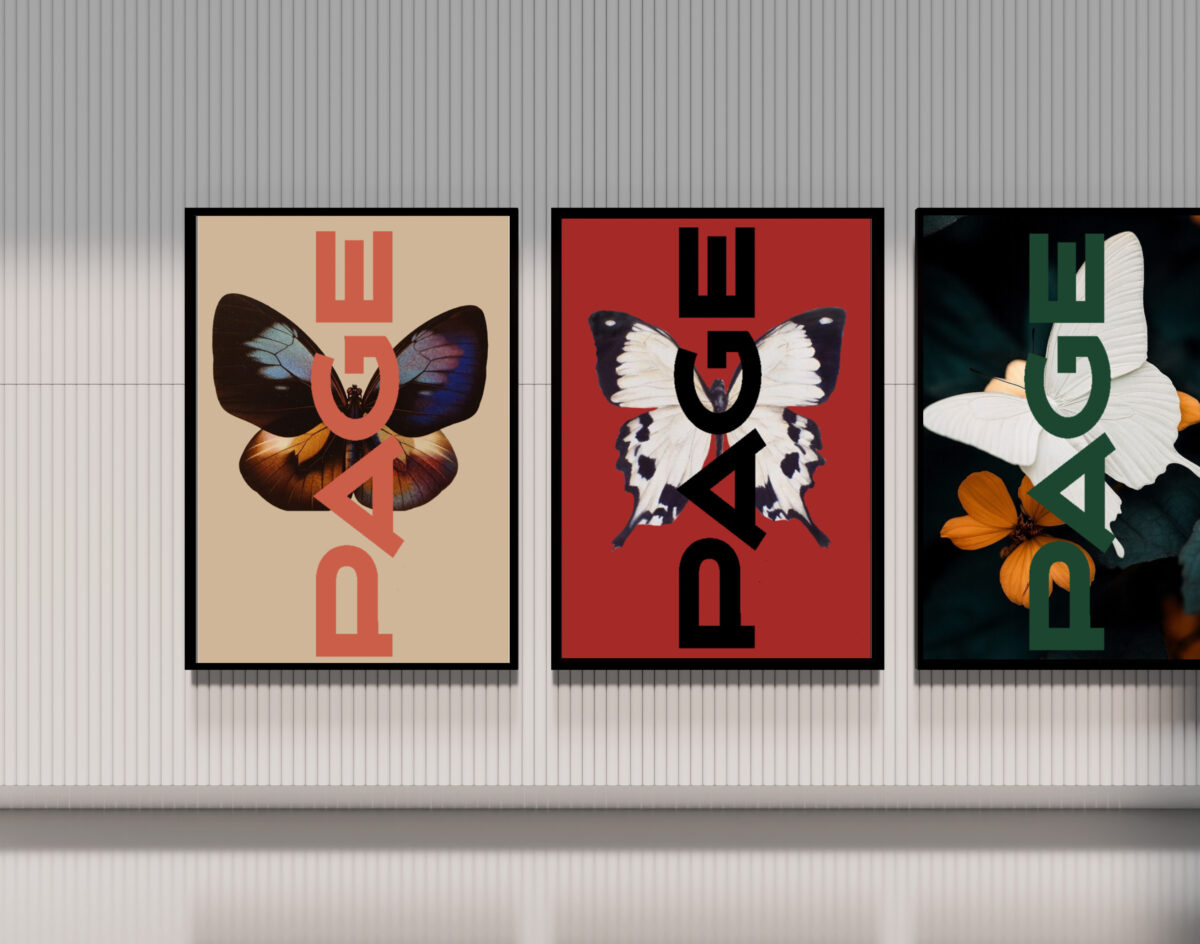
A magazine turns forty. The conventional response is retrospective: archive, celebration, the self-congratulation of endurance. But the cultural moment made nostalgia unavailable.
In 2024, for the first time in recorded history, the global average temperature exceeded 1.5°C above pre-industrial levels. 56 armed conflicts were active simultaneously — the highest number since World War II. And the creative industry confronted a technology that, for the first time, could produce images, text, and design without human intervention — at a scale no human workforce could match.
A birthday campaign for Page Magazine — one of Germany’s leading publications for design, communication, and creative culture — could not simply celebrate forty years. It had to answer a question the industry had not yet learned to ask cleanly: what is the value of human creativity when the tool that threatens to replace it may also be the most powerful instrument available for addressing the crises humanity has made?
The brief asked for a campaign. The cultural moment required a position.
The butterfly does not choose transformation. It is the only biological option available at a certain stage of development. The chrysalis is not a metaphor for patience. It is a state of radical structural dissolution — the organism becoming liquid before it becomes new. This is not a hopeful image. It is an accurate one.
The brutalist city that frames this campaign is not a stylistic choice. It is a portrait of the world as it currently operates: rational, efficient, scalable, impersonal — and producing outcomes that no individual within it intended or wanted. It is also, precisely, the environment that AI was built to optimise.
Against that environment, the butterfly is not decorative. It is diagnostic. It names what the system produces abundantly — and what it structurally cannot: the warm, the anomalous, the deliberately made. The anomaly that survives the system is the one that was never produced by it. Not optimised. Not generated. Arrived at through friction, choice, and embodied time.
Every campaign contains one decision that determines everything downstream. Here it was this: the setting would not be nature. The butterfly would emerge from concrete. That single choice made the art direction structurally coherent with its argument. Transformation does not require ideal conditions. It happens inside systems, despite them.
The visual system followed from that decision. Total desaturation in the environment. One warm element. The eye finds it without being told — because that is how meaning works when it is real rather than produced.
The cover arc extends the argument across three issues: the first nearly empty, the third overflowing. The cover performs what it cannot explain — that things of value take time and cannot be generated on demand. Each issue carries paper embedded with wildflower seeds: design becomes nature, not as metaphor but as material fact.
Campaign concept and creative direction. Art direction across three campaign images and a three-issue cover arc. Visual system development: colour logic, typographic register, image hierarchy. Seed card design integrating print and material experience. Strategic framing positioning the campaign as a cultural argument for the value of human editorial intelligence in an AI-saturated market.
This campaign was not briefed as a cultural statement. It was briefed as a birthday campaign. The cultural framing was the consulting contribution — the reading that elevated a celebratory brief into a positioning argument for the creative industry at the moment it matters most.
Page at 40 is not a magazine that survived technology. It is a magazine that embodies what technology structurally cannot: four decades of accumulated editorial judgment. A culture of selection. A discipline of meaning.
In a world that needs transformation, the creative who has already been through the chrysalis is not a relic. She is the most relevant person in the room.